



Solving Quadratic Equations by Factoring
Purplemath
This lesson covers many ways to solve quadratics, such as taking square roots, completing the square, and using the Quadratic Formula. But we'll start with solving by factoring.
(Before reaching the topic of solving quadratic equations, you should already know how to factor quadratic expressions. If not, first review how to factor quadratics.)
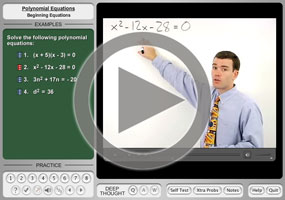
You've already factored quadratic expressions. The new thing here is that the quadratic expression is part of an equation, and you're told to solve for the values of the variable that make the equation true.
How to solve a quadratic equation by factoring
- Put the quadratic expression on one side of the "equals" sign, with zero on the other side.
- Factor the quadratic expression into its two linear factors.
- Set each of these linear factors equal to zero, creating two linear equations.
- Solve the two linear equations.
Note: This process finds the zeroes (or solutions, or roots, or x-intercepts) of the quadratic by using the fact that a multiplication is equal to zero only if at least one of the factors being multiplied is equal to zero. (This is called the "Zero-Product Property".) This property says something that seems fairly obvious, but only after it's been pointed out to us; namely:
Zero-Product Property: If we multiply two (or more) things together and the result is equal to zero, then we know that at least one of those things that we multiplied must also have been equal to zero. Put another way, the only way for us to get zero when we multiply two (or more) factors together is for one of the factors to have been zero.
So, if we multiply two (or more) factors and get a zero result, then we know that at least one of the factors was itself equal to zero. In particular, we can set each of the factors equal to zero, and solve the resulting equation for one solution of the original equation.
We can only draw the helpful conclusion about the factors of the quadratic (namely, that one of those factors must have been equal to zero, so we can set the factors equal to zero) if the product itself equals zero. If the product of factors is equal to anything non-zero, then we can not make any claim about the values of the factors.
Therefore, when solving quadratic equations by factoring, we must always have the equation in the form "(quadratic expression) equals (zero)" before we make any attempt to solve the quadratic equation by factoring.
- Solve (x − 3)(x − 4) = 0 by factoring.
Okay, this quadratic is already factored for me. But how do I use this factorisation to solve the equation?
The Zero Factor Principle tells me that at least one of the factors must be equal to zero. Since at least one of the factors must be zero, then I can set each of the factors equal to zero:
x − 3 = 0 or x − 4 = 0
This gives me simple linear equations, and they're easy to solve:
x = 3 or x = 4
And these two values are the solution they're looking for:
x = 3, 4
Note that "x = 3, 4" means the same thing as "x = 3 or x = 4"; the only difference is the formatting. The "x = 3, 4" format is more common.
- Solve x2 + 5x + 6 = 0, and check.
This equation is already in the form "(quadratic) equals (zero)" but, unlike the previous example, this isn't yet factored. I MUST factor the quadratic first, because it is only when I MULTIPLY and get zero that I can say anything about the factors and solutions. I can't conclude anything about the individual terms of the unfactored quadratic (like the 5x or the 6), because I can add lots of stuff that totals to zero.
So the first thing I have to do is factor:
x2 + 5x + 6 = (x + 2)(x + 3)
Now I can restate the original equation in terms of a product of factors, with this product being equal to zero:
(x + 2)(x + 3) = 0
Now I can solve each factor by setting each one equal to zero and solving the resulting linear equations:
x + 2 = 0 or x + 3 = 0
x = −2 or x = − 3
These two values are the solution to the original quadratic equation. So my answer is:
x = −3, −2
I'm not done, though, because the original exercise told me to "check", which means that I need to plug my answers back into the original equation, and make sure it comes out right. In this case, I'll be plugging into the expression on the left-hand side of the original equation, and verifying that I end up with the right-hand side; in other words, I need to confirm that plugging in these solution values results with the left-hand side equalling 0:
checking x = −3:
[−3]2 + 5[−3] + 6
9 − 15 + 6
9 + 6 − 15
15 − 15
0
checking x = −2:
[−2]2 + 5[−2] + 6
4 − 10 + 6
4 + 6 − 10
10 − 10
0
When an exercise specifies that you should solve "and check", they're looking for you to show that you've plugged your answers into the original exercise and gotten something that worked out right. The above, where I showed my checks, is all they're wanting. Just make sure to do your work neatly.
By the way, you can use this "checking" technique to verify your answers to any "solving" exercise. So, for instance, if you're not sure of your answer to a "factor and solve" question on the next test, try plugging your answers into the original equation, and confirming that your solutions lead to true statements.
- Solve x2 − 3 = 2x.
This equation is not in "(quadratic) equals (zero)" form, so I can't try to solve it yet. The first thing I need to do is get all the terms over on one side, with zero on the other side. Only then can I factor and solve:
x2 − 3 = 2x
x2 − 2x − 3 = 0
(x − 3)(x + 1) = 0
x − 3 = 0, x + 1 = 0
x = 3, x = −1
Then my solution is:
x = −1, 3
- Solve (x + 2)(x + 3) = 12.
It is very common for students to see this type of equation, and say:
"Cool! It's already factored! So I'll set the factors equal to 12 and solve to get x = 10 and x = 9. That was easy!"
Yeah, that was easy; it was also wrong. Very, very wrong.
Besides the fact that neither (10 + 2)(10 + 3) nor (9 + 2)(9 + 3) equals 12, we should never forget that we must have "(quadratic) equals (zero)" before we can solve by factoring.
Returning to the exercise:
Tempting though it may be, I cannot set each of the factors on the left-hand side of the equation equal to the other side of the equation and solve. Doing so would give me an entirely-wrong mess.
Instead, I first have to multiply out and simplify the left-hand side, then subtract the 12 over to the left-hand side, and re-factor. Only then can I solve.
(x + 2)(x + 3) = 12
x2 + 5x + 6 = 12
x2 + 5x − 6 = 0
(x + 6)(x − 1) = 0
x + 6 = 0, x − 1 = 0
x = −6, x = 1
Then my solution is:
x = −6, 1
- Solve x2 + 5x = 0.
This two-term quadratic is easier to factor than were the previous quadratics: I see immediately that I can factor an x out of both terms, taking the x out front. This gives me:
x (x + 5) = 0
A very common mistake that students make at this stage is to "solve" the equation for "x + 5 = 0" by dividing through by the x. But that's an invalid step. Why? Because we can't divide by zero. How does that come into play here?
Dividing through by the factor x makes the implicit assumption that x was not equal to zero. There is absolutely no justification for making that assumption! And making that assumption would cause us to lose half of our solution to this equation.
Returning to the exercise:
I need to remember that it's okay for a factor to contain only a variable, without being added to other terms; in particular, "x" is a perfectly valid factor. I need to set both of the factors equal to zero, and then solve the two resulting linear equations:
x(x + 5) = 0
x = 0, x + 5 = 0
x = 0, x = −5
Then my solution is:
x = 0, −5
The previous example had two terms and was easy to factor. There is one other case of two-term quadratics that we can factor to solve. It's only a bit more complicated:
- Solve x2 − 4 = 0.
This equation is in "(quadratic) equals (zero)" form, so it's ready for me to solve by factoring. But how do I factor this? By noticing that this is a difference of squares. I'll apply the difference-of-squares formula that I've memorized:
x2 − 4 = 0
(x − 2)(x + 2) = 0
x − 2 = 0, x + 2 = 0
x = 2, x = −2
Then my solution is:
x = −2, 2
Note: The solution above can also be formatted as "x = ± 2". This is pronounced as "x is equal to plus or minus 2".
The last example above leads us into how to solve by taking square roots, on the next page.
© 2024 Purplemath, Inc. All right reserved. Web Design by 