



Solving Multi-Step Linear Equations
Purplemath
In the previous two pages, we've looked at solving one-step linear equations; that is, equations that require one addition or subtraction, or that require one multiplication or division. However, most linear equations require more than one step in order to find their solution. What steps then should be used, and in what order?
For multi-step linear equations, we'll be using the same steps as we have previously; the only difference is that we won't be done after one step. We'll still have to do at least one more step. In what order should these steps be done? Well, that's going to vary with the equation, but there are some general guidelines which can prove helpful.
-
Solve 7x + 2 = −54
The variable is on the left-hand side (LHS) of the equation. It is currently multiplied by seven, and then it has a two added to it. I need to undo the "times seven" and the "plus two".
There is no rule about which "undo" operation I should do first. However, if I first divide through by 7, I'm definitely going to create fractions. Personally, I prefer to avoid fractions if possible, so I almost always do any plus / minus before any times / divide. I might end up having to deal with fractions anyway, but at least I can put them off until closer to the end of my work.
Starting with the "plus two" first, I'll subtract two from either side of the equation. Only then will I divide through by the seven. My work looks like this:
7x + 2 = -54
-2 -2
------------
7x = -56
-- ---
7 7
x = -8
By doing the plus / minus first, I avoided fractions. As you can see, the answer doesn't involve fractions, so I did myself a favor by doing the dividing-through last. My solution is:
x = −8
Formatting your homework and showing your work in the manner I have done above is, in my experience, fairly universally acceptable. However (warning!), it is also a good idea to clearly rewrite your final answer at the end of each exercise, as shown (in purple) above. Don't expect your grader to take the time to dig through your work and try to figure out what you probably meant your answer to be. Format your work so as to make your meaning clear.
-
Solve −5x − 7 = 108
In this equation, the variable (on the left-hand side) is multiplied by a minus five, and then a seven is subtracted from it. In hopes (as always!) of avoiding fractions, I'll add seven to either side of the equation first. Only then will I divide through by the minus five. My work looks like this:
-5x - 7 = 108
+7 +7
-------------
-5x = 115
--- ---
-5 -5
x = -23
I've shown my work neatly. Now I'll clearly rewrite my solution at the end of my work:
x = −23
-
Solve 3x − 9 = 33
The variable (on the left-hand side of the equation) is multiplied by a three, and then a nine is subtracted from it. I'll take care of the nine first, and then the three:
3x - 9 = 33
+9 +9
-----------
3x = 42
-- --
3 3
x = 14
In this case, again, my solution has no fractions:
x = 14
-
Solve 5x + 7x = 72
In this equation, I have two terms on the left-hand side that contain variables. So my first step is to combine these "like terms" on the left. Then I can solve:
5x + 7x = 12x
So now my equation is:
12x = 72
Even though it might initially have looked more complicated, this is actually a one-step equation. I'll solve by dividing through by twelve:
12x = 72
--- --
12 12
x = 6
My answer is:
x = 6
-
Solve 4x − 6 = 6x
In this equation, I've got terms with variables on either side of the equation. To solve, I need to get those variable terms all on one side of the equation.
There is no rule saying which of the two terms I should move, the 4x or the 6x. However, I've learned from experience that, to avoid negative coefficients on my variables, I should move the x term with the smaller coefficient. That means, in this case, that I'll subtract the 4x from the left-hand side over to the right-hand side:
4x - 6 = 6x
-4x -4x
-------------
-6 = 2x
And now I have a one-step equation, which I'll solve by dividing through by two:
-6 = 2x
-- --
2 2
-3 = x
My solution is:
x = −3
In the above exercise, the variable (in my working) ended up on the right-hand side of the equation. This is perfectly okay. The variable is not "required" to end up on the left-hand side of the equation; we're just used to seeing it there. So the result "−3 = x" is perfectly okay, and means exactly the same thing as "x = −3".
However (warning!), I have heard that some instructors insist that the variable be placed on the left-hand side of the equation in the final answer. (No, I'm not making this up.) So, even though the "−3 = x" is perfectly valid in the working, those instructors will count this as "wrong" if you leave the answer this way. If you have any doubts about your instructor's formatting preferences, ask now.
-
Solve 8x − 1 = 23 − 4x
In this equation, I've got variables on either side of the equation, and also loose numbers on either side. I need to get the variable terms on one side, and the loose numbers on the other side. Because I'd like to avoid negative coefficients on my variables, I'll be moving the smaller of the two terms; namely, the −4x that's currently on the right-hand side. To get the loose numbers on the side opposite the variable terms, I'll be moving the −1 that's currently on the left-hand side. There is no particular "right" order for doing these steps; since they're both a matter of adding, people usually do them together in one step. I'll do the variable terms first, and then the loose numbers:
8x - 1 = 23 - 4x
+4x +4x
-----------------
12x - 1 = 23
+1 +1
------------
12x = 24
At this point, I've got a one-step equation which requires one division to solve:
12x = 24
--- --
12 12
x = 2
Then my answer is:
x = 2
If, in the above, I'd done the first two steps at one go, it would have looked like this:
8x - 1 = 23 - 4x
+4x +1 +1 +4x
-----------------
12x = 24
--- --
12 12
x = 2
It's probably a good idea, when you're just starting out, to do each step separately. But once you get comfortable with the process (and are reliably arriving at the correct values), feel free to start combining some steps.
-
Solve 5 + 4x − 7 = 4x − 2 − x
This equation is all kinds of messy! Before I can solve, I'll need to combine the like terms on either side of the equation:
5 + 4x − 7 = 4x − 2 − x
(5 − 7) + 4x = (4x − 1x) − 2
−2 + 4x = 3x − 2
Now that I've simplified each side of the equation, I can do the solving.
-2 + 4x = 3x - 2
-3x -3x
-----------------
-2 + 1x = -2
+2 +2
-----------------
1x = 0
I added the (usually unstated) 1 to the variable term on the right-hand side of the original equation in order to help me keep track of what I was doing; it isn't "necessary". And it isn't expected on the final answer, which is properly stated as:
x = 0
It is perfectly fine for x to have a value of zero. Zero is a valid solution. Do not say that this equation has "no solution"; it does indeed have a solution, that solution being x = 0.
-
Solve 0.2x + 0.9 = 0.3 − 0.1x
This equation solves just like all the other linear equations I've done. It just looks worse because of the decimals. But that's easy to fix!
Whatever is the largest number of decimal places in any of the coefficients, I can multiply through on both sides by "1" followed by that number of zeroes. In this case, all of the decimals have one decimal place, so I'll multiply through by 10:
10(0.2x + 0.9) = 10(0.3 − 0.1x)
10(0.2x) + 10(0.9) = 10(0.3) − 10(0.1x)
2x + 9 = 3 − 1x
Now I can solve as usual:
2x + 9 = 3 - 1x
+1x +1x
-----------------
3x + 9 = 3
-9 -9
------------
3x = -6
-- --
3 3
x = -2
Just because the original equation had decimal places, doesn't mean that I'm stuck working with them. File this trick away for later; it'll come in handy.
x = −2
By the way, if the coefficent with the most decimal places had had two decimal places, then I'd have multiplied through on both sides of the equation by 100; for three decimal places, I'd have multiplied through by 1000; and so forth.
-
Solve
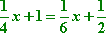
Ick! Fractions! But, just as with the decimals in the previous exercise, I don't have to be stuck with fractions. In this case, I'll be multiplying through to "clear" the denominators, giving me a nicer equation to solve.
To simplify my computations for equations with fractions, I will first multiply through on both sides by the common denominator of the various fractions. For this equation, the common denominator is 12, so I'll multiply everything by 12 (or, when multiplying against a fraction, I'll multiply by ):
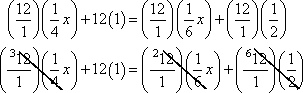
This is now a much nicer equation to work with. I'll continue my solution by subtracting the smaller 2x from either side:
3x + 12 = 2x + 6
-2x -2x
------------------
1x + 12 = 6
-12 -12
------------------
1x = -6
I'll remove the 1 from the variable when I write my final answer:
x = −6
© 2024 Purplemath, Inc. All right reserved. Web Design by 