



Fractional (Rational) Exponents
Purplemath
What is a rational (or fractional) exponent?
A rational (that is, a fractional) exponent is a power that is expressed as a fraction, and which represents a radical. For instance, the expression means "the cube root of eight", or , which is 2.
What are the rules for rational exponents?
The rules for rational exponents are the same as the rules for integer exponents:
- Product property: ( xm ) ( xn ) = xm + n
- Power of a power property: ( xm )n = xm × n
- Power of a product property: (xy)m = xmym
- Power of a quotient property:
- Quotient property:
- Negative power property:
How do you do fractional (or rational) exponents?
To convert an expression from radical form to fractional (or rational) exponent form, you convert the n-th root to the power. Working in the other direction, you convert the 1/n-th power to the n-th root.
For example, we can write the square (or "second") root as the one-half power, like this:

...or:

...which evaluates to (that is, which simplifies as) 2.
The cube (or "third") root is the one-third power:

The fourth root is the one-fourth power:

The fifth root is the one-fifth power, and so on.
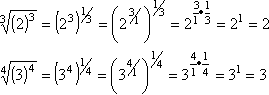
You probably know that exponents and radicals can cancel each other out; for instance, the square of a square root of a number will give you that number as a result. The fractional powers, being radicals, work the same way, but when the radicals are converted to fractional powers, the cancelling is a bit more obvious:
You can enter fractional exponents on your calculator for evaluation, but you must remember to use parentheses. If you are trying to evaluate, say, , you must put parentheses around the , because otherwise your calculator will think you mean (154) ÷ 5. In other words, enter the expression into your calculator like this:
Fractional exponents allow greater flexibility (which you'll see a lot of in calculus), are often easier to write than the equivalent radical format, and permit you to do calculations that you couldn't do before. For instance:

Whenever you see a fractional exponent, remember that the numerator (that is, the top number) is the power, and the denominator (that is, the bottom number) is the root. For instance:
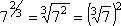
And, yes, you can be flexible with the order of the parts of the fractional power. That's why it's perfectly okay that I had the square inside the radical in one version and outside the radical in the other.
By the way, some decimal powers can be written as fractional exponents, too. If you are given something like 35.5, recall that , so:
Generally, though, when they give you a base raised to a decimal power (that is, a power that is something other than a fraction or a whole number), you should just leave it as it is, or, if necessary, evaluate it in your calculator. For instance, 3π — where π is the number you learned about in geometry, and is approximately equal to 3.14159 — cannot be simplified or rearranged as a radical.
A technical point: From time to time, you might have to take account of the fact that you are taking even roots, because even roots require non-negative values for the corresponding radicals to be defined. To illustrate what I'm talking about, suppose you start with the number −2, and you square this and take the square root, a process which is usually regarded as the radical and the power "cancelling" with each other. But:
![sqrt[ (-2)^2 ] = sqrt(4) = 2, does not equal -2](exponent/exp23.gif)
You put in a negative number, did two processes which are supposed to cancel out, but got a positive number. In particular, you did not get what you'd started with. So you sometimes have to be very careful with even roots.
However, this "plug in a negative value and get the same value out, but now it's positive" thing should sound familiar. Why? Because this is the official definition of absolute value:

Yeah, I know: they never told you that this is the technical definition, but at some point they expect you to know somehow, so I'm telling you now.
So if they give you, say, x3/6, then x had better not be negative, because x3 would still be negative, and you would be trying to take the sixth root of a negative number.
If they give you x4/6, then a negative x becomes positive (because of the fourth power) and is then sixth-rooted, so it becomes | x |2/3 (by reducing the fractional power). On the other hand, if they give you something like x4/5, then you don't have to care whether x is positive or negative, because a fifth root doesn't have any problem with negatives.
(By the way, these considerations are irrelevant if your book specifies that you should "assume all variables are non-negative".)
A technological point: Calculators and other software do not compute things the way people do; they use pre-programmed algorithms. Sometimes the particular method the calculator uses can create difficulties in the context of fractional exponents.
For instance, you know that the cube root of −8 is −2, and the square of −2 is 4, so (−8)(2/3) = 4. But some calculators return a complex value or an error message, as is the case with one of my graphing calculators:
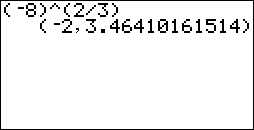
Clearly, this isn't the expected result, especially if you haven't yet studied complex numbers. This calculator answer isn't helpful.
In Microsoft Excel, if you enter "=(−8)^(2/3)" into a cell, the spreadsheet returns the error "#NUM!" (that is, "not a number!"), another unhelpful answer.
Some calculators and programs will do the computations as expected, as displayed below from my other graphing calculator:
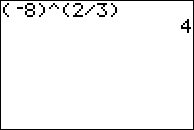
The difference has to do with the pre-programmed calculating algorithms. These algorithms generally try to do the computations in ways which require the fewest operations;, in order to process what you've entered as quickly as possible.
But sometimes the fastest method isn't always the most useful, and your calculator will choke.
Fortunately, you can get around the problem. By splitting the numerator and denominator of the fractional power, you can enter the expression so that your calculator should arrive at the correct value. After getting the unhelpful answer in my first calculator, I re-entered the number with the power broken into pieces:
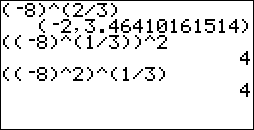
As you can see above, it didn't matter if I first took the cube root of negative eight and then squared, or if I first squared and then cube-rooted; either way, by feeding the numerator and denominator to the calculator separately, I was able to get the calculator to return the proper value of 4.
If you're not sure how your calculator will respond, test it by entering the expressions shown on my calculator screens. Make sure that you know now, before the next test, what you have to do in order to get your calculator to play nice.
© 2024 Purplemath, Inc. All right reserved. Web Design by 